
This is part 1 of a two part series of how we study History at Emmanuel. In this post we look at our curriculum and in the second post we will consider the philosophy which underlies our approach.

Each Friday at Emmanuel children from Years 1 to 6 study History for 90 minutes. If we were to take a survey of the school, History would probably come out on top as favourite subject. How do we teach it and why do our children enjoy it so much? One of the reasons is the course we use. It’s called ‘The Story of the World for the Classical Child’ and does what it says on the tin:
It tells History as a story
History contains dates so we can place pieces of the story in order, but fundamentally History is the story of people’s interactions with one another, within civilisations and between them, positive and negative. Events and dates are shaped by these interactions and need to be put in the context of them to make sense. History is essentially a telling of the human story, so hearing those human stories makes it come alive in the imagination of children.
It tells the story of the world
Our children start History in the early civilisations of Mesopotamia but by week 15 have travelled across all the continents. Because History is a human story, this tour of the world helps children see the universals of human nature shown across the world but also appreciate cultural distinctives. We encourage children to recognise that each culture has stories which have shaped and defined it while encouraging them to consider which stories have uniquely shaped and defined their own.
It tells History with a classical purpose
The course follows the principle of the ‘trivium’, the foundation of classical education, giving children a grounding in the elements of each subject. When a child leaves Emmanuel at the end of Year 6 they have travelled from Early History to the 20th century and across the world. Through this they understand the broad contours of History so that any event, discovery, poem, work of art which they learn about can be put in context.
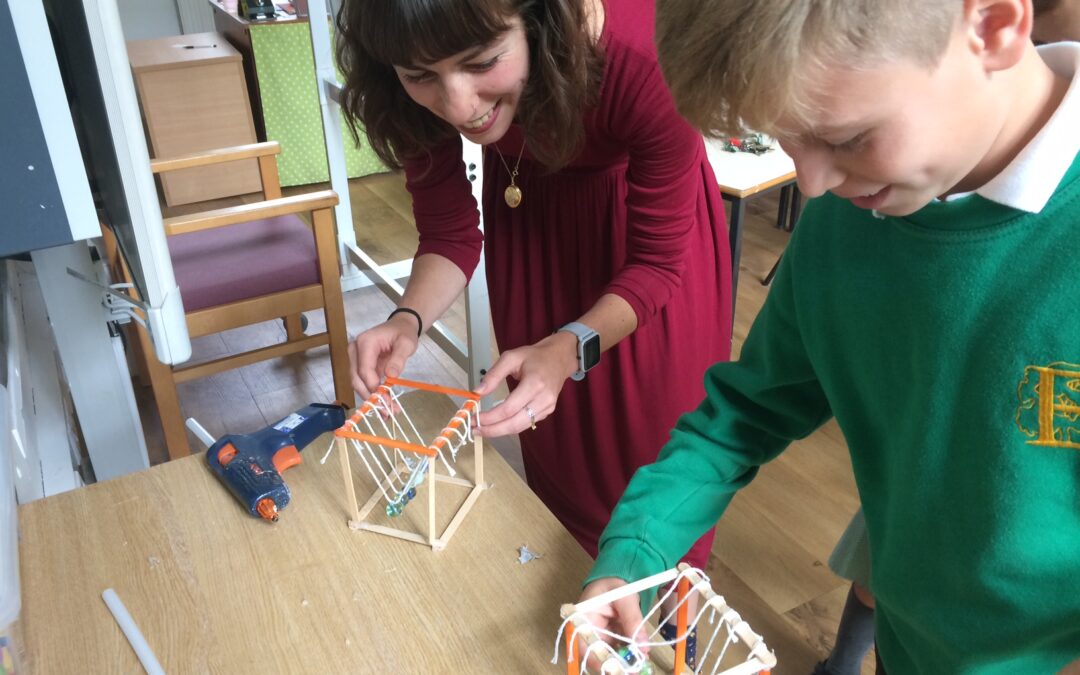
A further aspect of the course we use is that each week children create an artefact from the era they are studying. This might be some printing, a rudimentary compass, a liberty bell, Newton’s cradle, an Olympic wreath, a cuneiform tablet. In the making of artefacts, children are given visual reminders of the culture they studied and artefacts they created. As they create and display their work, they are illustrating that History is not just a linear story but a discipline which can be pursued in many dimensions.
You can learn more about the course we use here.
